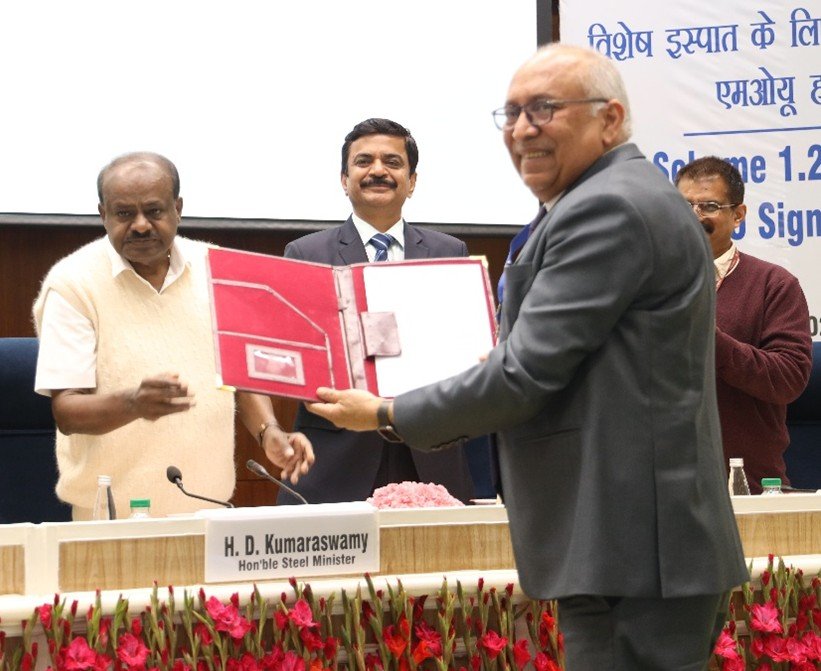


New Delhi: Jindal Stainless, India’s leading stainless steel manufacturer, has signed a Memorandum of Understanding (MoU) with the Ministry of Steel, Government of India, under the newly launched Production Linked Incentive (PLI) 1.2 scheme for speciality steel. Aligned with the vision of Hon’ble Prime Minister Shri Narendra Modi ji, the scheme marks a significant step towards strengthening India’s high-value manufacturing capabilities and reducing import dependence in critical speciality steel and stainless steel grades. The MoU was signed at Vigyan Bhawan, New Delhi, in the presence of Union Minister for Steel and Heavy Industries, Shri H. D. Kumaraswamy. Jindal Stainless was represented by Vijay Sharma, Director – Corporate Affairs.
The PLI 1.2 scheme has been launched in response to strong industry demand and the need for sustained capacity expansion in specialty steel and stainless steel grades critical to strategic sectors such as railways, defence, electrical equipment, and aerospace. Under the scheme, 85 MoUs have been signed with 55 companies, with committed investments of ₹11,887 crore for a planned capacity addition of 8.7 million tonnes of speciality steel by FY 2031. As part of the MoU, Jindal Stainless will undertake capacity augmentation, already a key part of the company’s long-term strategy in line with country’s growing demand of stainless steel, along with adding new capacity for value-added products, including specialised alloys and forged products.
At the MoU signing ceremony (from left to right): Union Minister for Steel and Heavy Industries, Shri H. D. Kumaraswamy ji; Secretary, Ministry of Steel, Shri Sandeep Poundrik ji; Joint Secretary, Ministry of Steel, Shri Abhijit Narendra ji; and Jindal Stainless, Director – Corporate Affairs, Mr Vijay Sharma
Speaking on the occasion, Jindal Stainless, Managing Director, Abhyuday Jindal, said, “Jindal Stainless has been steadily scaling up its capacities and capabilities, which remain a central and continuous pillar of our growth strategy, aligned with the nation’s growing demand of stainless steel across key strategic sectors. We welcome this policy, which further reinforces industry confidence to invest in advanced manufacturing, while ensuring that India builds a resilient and future-ready speciality stainless steel base to support national priorities and economic growth.”
Speaking during the MoU signing ceremony, Jindal Stainless, Director – Corporate Affairs, Vijay Sharma said, “Through this strategic MoU, we are proud to contribute to a resilient and future-ready stainless steel value chain that can meet the evolving requirements of strategic and high-growth sectors. We appreciate the Government’s support through enabling policies that advance this ambition and strengthen the domestic industry’s long-term competitiveness.”
For Jindal Stainless, the launch of PLI 1.2 aligns closely with the company’s ongoing and planned investments in stainless steel and allied speciality grades. The company has been steadily expanding its manufacturing capabilities to cater to growing domestic demand as well as emerging global opportunities, with a focus on value-added products and advanced applications.
Stainless steel plays a critical role across a wide spectrum of end-use sectors. From long-life infrastructure and clean energy systems to railways, urban mobility, automobiles, and industrial equipment, demand for high-quality stainless steel continues to rise. As India accelerates investments in infrastructure, renewable energy, transport networks, and manufacturing, the need for reliable domestic production of speciality steel and stainless steel grades becomes increasingly important.
The launch of PLI 1.2 builds on the momentum of earlier rounds of the scheme, which have seen committed investments of over ₹40,000 crore, translating into significant capacity creation and employment generation across the steel sector ecosystem. PLI 1.2 carries this momentum and is expected to act as an important enabler for import substitution and deeper integration of Indian manufacturers into global value chains