
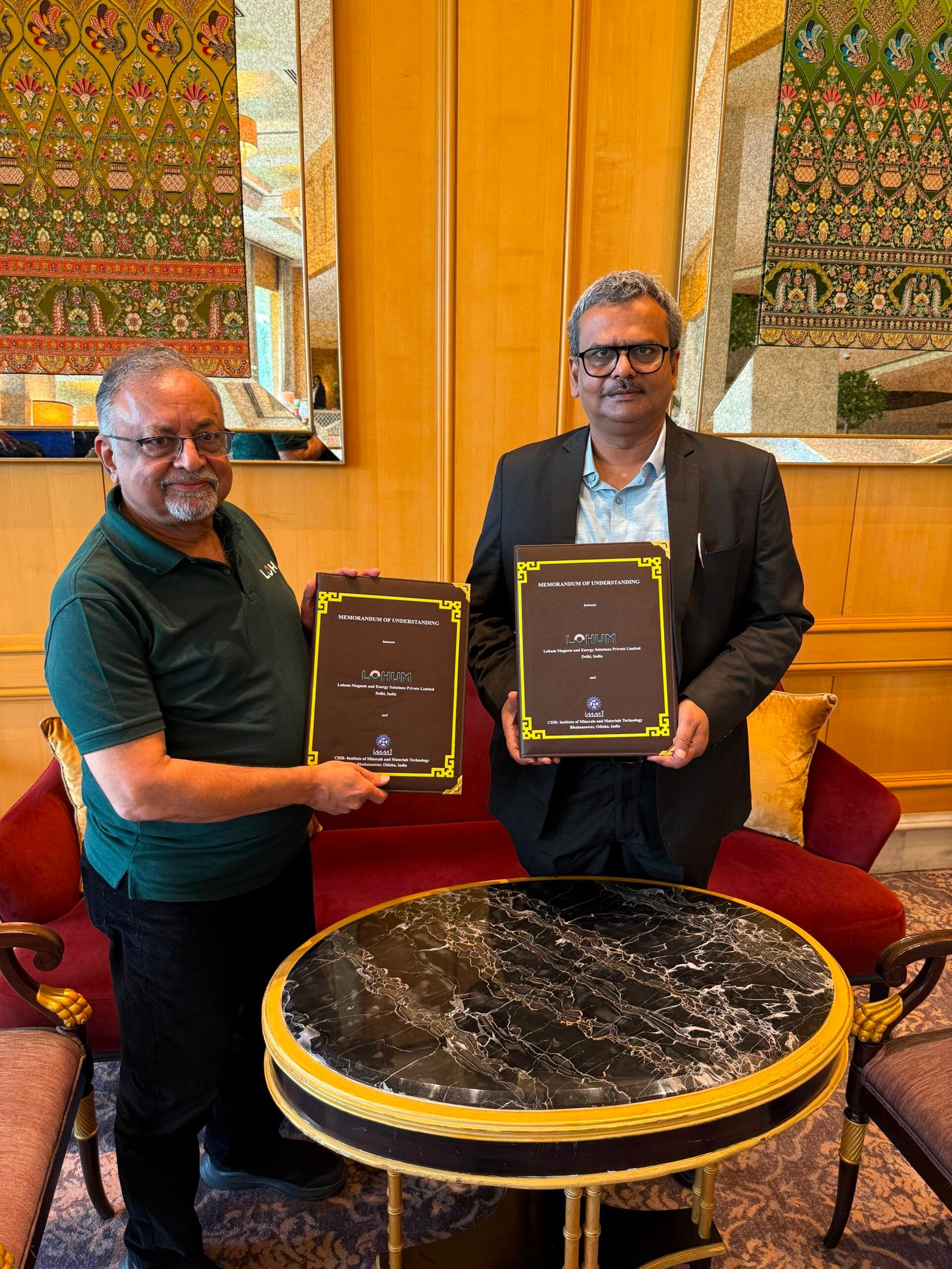


Greater Noida: Rare-earth permanent magnets are essential components in electric vehicles, renewable-energy systems, advanced electronics, industrial automation, defence equipment, and several other strategically important applications, yet India remains heavily dependent on imports across this value chain. Establishing domestic capabilities in this space is vital to the country’s industrial resilience, technological sovereignty, and long-term economic security.
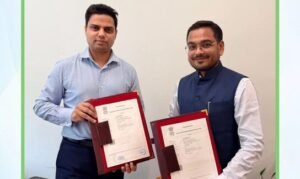
Against this backdrop, LOHUM, India’s largest diversified producer of sustainable critical minerals and advanced materials, and the Council of Scientific and Industrial Research–Institute of Minerals and Materials Technology (CSIR-IMMT) have signed a Memorandum of Understanding to jointly advance indigenous technology capabilities for the production of critical rare-earth materials used in high-performance permanent magnets.
The partnership represents an important step towards strengthening India’s domestic rare-earth value chain and building the technological foundation required for large-scale manufacturing of sintered rare-earth permanent magnets in the country. It also represents an industry-government alliance in support of the Government of India’s efforts to establish an integrated domestic ecosystem for sintered rare-earth permanent magnets and reduce the country’s dependence on imported technologies and materials.
Through this collaboration, LOHUM and CSIR-IMMT will combine scientific research, process-development expertise, and industrial execution capabilities to develop and validate technologies for the production of metallized neodymium-praseodymium (NdPr), one of the core materials needed for manufacturing high-performance rare-earth permanent magnets. The technology being jointly developed is a much safer alternative to the commonly used metal removal by ladle process of Molten Salt Electrolysis.
The CSIR–Institute of Minerals and Materials Technology (CSIR-IMMT), Bhubaneswar, is a premier national R&D institution dedicated to mineral processing, extractive metallurgy, materials development, and critical minerals recovery. The institute hosts the Centre of Excellence on Critical Minerals under the National Centre for Minerals and Materials (NCMM), which brings together academia, R&D laboratories, and industry to develop indigenous technologies. LOHUM, a key spoke of the CSIR-IMMT Centre of Excellence, brings its experience in refining and recycling critical minerals, manufacturing advanced materials, and developing an integrated rare-earth permanent magnet manufacturing platform in India. Together, the organisations aim to bridge the gap between laboratory research and industrial deployment, establishing a pathway for indigenous rare-earth technologies to be implemented at commercial scale. Dr Kali Sanjay, Chief Scientist and Head, Business Development and CSIR-IMMT CoE, noted that the collaboration would enable faster translation of indigenous rare earth processing technologies into industrial applications.
For LOHUM, this collaboration forms part of a broader strategy to build an integrated platform for critical materials and rare-earth permanent magnets in India, spanning feedstock, refining, advanced materials, and finished magnet production. The company views the partnership as central to supporting both domestic manufacturing needs and the diversification of global rare-earth supply chains, a priority that is only growing more urgent as clean-energy, mobility, and advanced-manufacturing industries worldwide seek more resilient, geographically diversified sources of supply.






[8242]jacktop লগইন এবং অ্যাপ ডাউনলোড | বিকাশ অনলাইন ক্যাসিনো,jacktop লগইন করুন এবং সেরা অনলাইন স্লট গেম উপভোগ করুন। বিকাশ দিয়ে অনলাইন ক্যাসিনো পেমেন্ট করে আজই jacktop app ডাউনলোড করে খেলা শুরু করুন। visit: jacktop