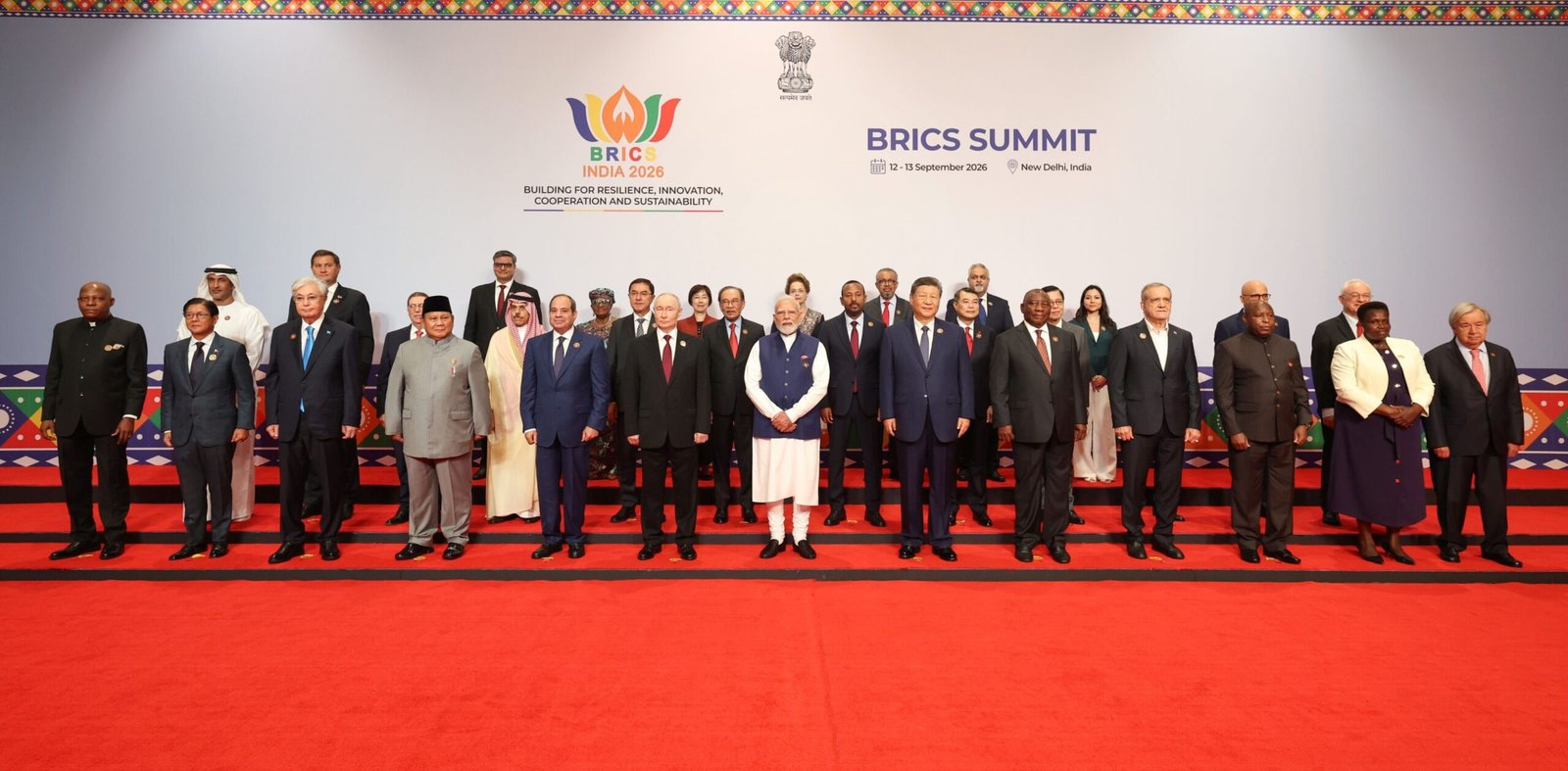


The 45-page New Delhi Declaration presents a broad and forward looking climate framework for BRICS, with India’s chairship helping bring together priorities, including climate action, development, energy security, resilience and finance, segments that are often treated separately. Recognising the fiscal constraints faced by developing economies in the backdrop of rising catastrophic climate events and the diminishing of the multilateral processes, the BRICS summit has successfully grounded the framework of Paris Agreement, equity and CBDR-RC to build a common platform that reflects the realities and priorities of the Global South.
Amid rising volatility and fractured geopolitical order, India’s chairship has achieved no small feat in reaching a consensus from a bloc which is as geopolitically diverse as the BRICS. The declaration emphasises implementation and practical cooperation and advances collaboration on carbon markets, climate research, community-based adaptation, smart grids, energy storage, hydrogen, critical minerals and transport decarbonisation. Days after Nepal witnessed devastation following a catastrophic climate event, the bloc’s declaration also placed greater emphasis on resilience, early warning systems and climate-resilient infrastructure, demonstrating a shift from broad commitments towards specific areas where BRICS countries can exchange expertise, build capacities and develop common approaches.
The New Delhi declaration places climate resilience across a much wider set of economic and development priorities than in previous formulations. Rather than treating climate as a discrete policy area, it links resilience to industrial policy, critical minerals, energy systems, supply chains, infrastructure, small-business finance, insurance and food security. The effect is to place climate risk within the broader question of how BRICS economies manage growth, investment and structural change.
That approach also runs through the declaration’s treatment of trade and industrial policy. It backs more resilient supply chains, greater participation by developing countries in higher-value manufacturing, cooperation on critical minerals, hydrogen, solar manufacturing, smart grids and financing for export-oriented small firms. At the same time, it pushes back against trade measures that BRICS members see as protectionist or extraterritorial, particularly where environmental standards are set without sufficient representation from emerging and developing economies.
The same argument appears in the sections on global governance. The declaration calls for greater representation of emerging and developing countries in the UN system, IMF quota reform, a correction in World Bank shareholding and restoration of the WTO dispute-settlement mechanism.
Taken together, these positions amount to a case for a more balanced multilateral system in amultipolar world, in which developing countries have a larger role in setting the rules that affect trade, finance and climate policy.
The declaration also retains a strong emphasis on national policy space. It stresses differentiated responsibilities, national circumstances and development pathways, while calling for climate finance, technology transfer and capacity-building from developed countries. Within BRICS itself, cooperation is framed largely as voluntary and member-led, with the New Development Bank expected to remain demand-driven rather than prescriptive.
Climate finance becomes part of the growth and development agenda
● Debt is identified as a barrier to climate investment. BRICS calls for coordinated action to improve debt sustainability and expand governments’ fiscal space, recognising that high debt burdens constrain both development and climate spending. Para 107.
● Adaptation appears directly in discussions involving central banks and finance ministries.
The declaration welcomes a central-bank report on sustainable and green finance, including adaptation, which examines financing gaps and the possibility of making projects more bankable. India’s Growth and Development Task Force brings together work on financial-system reform, climate finance and climate vulnerabilities. Paras 96 and 100.
● BRICS seeks more financing options for developing economies. It supports expanding NDB resource mobilisation, local-currency lending and infrastructure investment. It also advances technical work and pilot transactions under the multilateral guarantees initiative inherited from Brazil, aimed at improving creditworthiness and reducing development-project financing costs. Paras 102 and 115.
● Adaptation includes a clear demand on developed countries. The declaration calls for additional, adequate, predictable and accessible adaptation finance, technology and capacity support. It welcomes principles combining community experience and traditional knowledge with science to strengthen resilience. Para 110.
Trade policy is linked explicitly to countries’ capacity to adapt
● Carbon border measures are challenged on climate and development grounds. The declaration opposes carbon border adjustment mechanisms that it describes as unilateral, punitive, discriminatory and protectionist, expressing concern that they undermine developing countries’ efforts to address climate impacts and build adaptive capacity. Para 108.
● BRICS couples opposition to protectionism with support for multilateral trade rules. It seeks restoration of a functioning WTO dispute-settlement system and warns that tariffs and protectionism pursued under environmental objectives can disrupt supply chains and deepen economic disparities. Paras 20–21.
● Cooperation on trade and carbon markets continues. The declaration supports further development of the BRICS trade-and-climate laboratory and climate research platform, implementation of the carbon-markets partnership, and dialogue on aligning carbon markets with adaptation goals. Para 109.
Industrial policy connects the energy transition with economic resilience
● Resource-rich countries should capture more economic value. BRICS links resilient critical-mineral supply chains with domestic value addition, economic diversification and sovereign control over resources. It also seeks greater developing-country participation in higher-value manufacturing through investment, technology transfer and industrial cooperation. Paras 67 and 84–86.
● Cooperation covers the infrastructure and technologies needed for energy transitions. The declaration welcomes smart-grid and storage principles, notes India’s proposed digital centre of excellence, encourages compatible hydrogen standards and supports development of a solar cooperation roadmap covering technology, finance and skills. Paras 65–66 and 70.
Resilience is built into infrastructure and food security
● Infrastructure policy emphasises prevention and preparedness. BRICS welcomes guidelines for integrating early-warning data and voluntary principles for climate-resilient urban infrastructure. It recognises the Coalition for Disaster Resilient Infrastructure’s role in technical assistance, policy and financing, and calls for anticipatory action and risk-informed planning. Paras 82–83.
● Food security includes preparation for climate shocks. The declaration supports drought-resilient and climate-adaptive seed systems alongside food reserves and measures addressing supply disruption and price volatility. It also welcomes a network of centres on agroecology and regenerative agriculture for climate resilience and productivity. Paras 60 and 62.
● Financial resilience includes shared risk expertise. Members continue discussions on an Insurance Resilience Centre and India’s proposed Risk Lab at GIFT City, alongside stronger reinsurance capacity. These remain proposals under discussion; the paragraph does not designate them as climate-finance facilities. Para 92.
Greater developing-country power in global institutions
● Representation should reflect the distribution of economic power. BRICS calls for IMF voting shares and World Bank shareholding to reflect developing economies’ growing weight, while protecting the poorest countries. It also seeks more representative, transparent selection of IMF and World Bank leadership. Paras 17–19.
● UN reform extends to both membership and leadership. The declaration seeks greater developing-country representation in the Security Council and senior UN positions, increased participation by women, and an end to national monopolies over senior posts. China and Russia reiterate support for India and Brazil to play a greater role in the UN, including its Security Council. Paras 8–10 and 13.
● The declaration defends developing countries’ place in the G20. It recognises the African Union’s accession during India’s presidency, reaffirms South Africa’s full membership and insists that membership changes require consensus. It explicitly commits to preserving the legacy of the consecutive Indonesian, Indian, Brazilian and South African G20 presidencies. Para 116.
Security policy focuses on protecting essential supplies and infrastructure
● Energy security is explicitly connected to national security and development. BRICS calls for stable supplies and protection of critical energy infrastructure alongside emissions reductions and equitable transitions. The text also retains a significant role for fossil fuels, particularly in developing economies. Its West Asia provisions call for protecting civilians and infrastructure and maintaining flows of trade, supply chains and energy. Paras 28 and 64–66.
● The climate-security framing has an explicit boundary. The declaration expresses concern that rising military spending comes at the expense of development finance. It also expresses concern about attempts to link security with the climate-change agenda. Its provisions support a strong account of resilience across economic, food and energy security, while preserving that distinction. Para 24.
Amb Manjeev Puri, Distinguished Fellow, The Energy Resource Institute (India), “The BRICS has reiterated some of the most important positions of the Global South. It is important that all these nations, who may have political disagreements, have stood together in unity on the critical issues of development and sustainability. We’ve strongly called out against unilateralism. Another important aspect is trying to explore what is possible in cross border trade and payments. Cooperation and working together helps create a system of resilience, build supply chains and payment chains. The point about resilience and working towards better disaster preparedness has been underscored. The declaration is a reaffirmation of the positions which the global south has always taken. Its reiteration today has its own significance as the world faces headwinds in terms of collaborative action and multilateralism.”
Li Shuo, Director, China Climate Hub, Asia Society Policy Institute, “BRICS is determined to chart its own course on climate and energy, one that emphasizes the alignment of development and decarbonization rather than treating them as competing priorities. The bloc’s explicit rejection of carbon border taxes, alongside its insistence that fossil fuels will remain part of the energy mix for emerging economies, signals that these leading Global South countries intend to define the terms of their own energy transition rather than have them imposed by others. The declaration also underscores the growing role of BRICS countries in global climate affairs, with Brazil having hosted the most recent COP and Ethiopia assuming the presidency of COP32. The real test for the group, however, will be how it responds to increasingly severe climate impacts that are already affecting its members and whether it can translate its rhetoric into stronger climate action.As Western countries retreat from climate commitments, how BRICS responds to this challenge will ultimately determine the kind of geopolitical force it becomes.”
Ulka Kelkar, Executive Director – Climate, Economics & Finance, WRI India, “At a time when climate change is increasing the frequency and severity of extreme weather, the New Delhi Declaration introduces several new and timely ideas on disaster risk reduction through international collaboration and community-led resilience building. The BRICS Voluntary Principles for Climate Resilient Urban Infrastructure call for integrating climate risk assessment into land use planning, which would be crucial to prevent maladaptation. The BRICS Insurance Resilience Centre and BRICS Risk Lab can facilitate cross-country disaster risk pooling as an alternative to conventional insurance approaches which have limited effectiveness in the face of climate change. BRICS countries are already large donors of climate finance, not just recipients, and the New Development Bank can continue to support projects for sustainable development and climate adaptation. Recognizing the vulnerability and the economic importance of micro, small and medium enterprises (MSMEs) in global value chains, financial access initiatives like the BRICS’ Guiding Principles for Credit Assessment Frameworks and the Jaipur Consensus can help make MSMEs more resilient to climate and economic shocks.”