
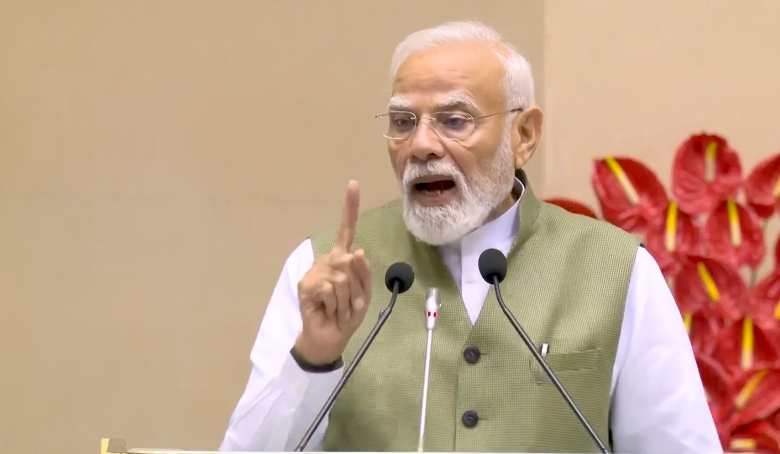


PM Modi said, “We all know that the responsibility for carbon emissions has often been wrongly placed on developing countries. Whereas the historical truth is that even today, India’s contribution to per capita carbon emissions is less than half of the global average.”
हम सब जानते हैं कि अक्सर Carbon emission की जिम्मेदारी गलत तरीके से विकासशील देशों पर डाली जाती रही है। जबकि ऐतिहासिक सच्चाई यह है कि आज भी प्रति व्यक्ति carbon emission में भारत का योगदान global average के आधे से भी कम है: माननीय प्रधानमंत्री श्री @narendramodi जी… pic.twitter.com/G1cIdTL43F
— Kiren Rijiju (@KirenRijiju) September 19, 2026
He said, “India is showing how development and environmental sustainability can go hand in hand.”
“Many of my companions from the Global South are present here. But the historical truth is that even today, India’s per capita carbon emissions are less than half the global average. In developed countries, per capita carbon emissions are six times higher than India’s. Six times higher. India presents this fact strongly on global platforms. And I say to every Indian – show your strength too. We have also presented our traditions and their power before the world. On these very subjects, during COP‑21 in Paris, we launched the book Convenient Action – Continuity for Change. We are establishing new benchmarks for environmental protection by taking the world along. Whether it is the vision of One Sun, One World, One Grid, or the International Solar Alliance, CDRI, Global Biofuel Alliance, International Big Cat Alliance, Mission LiFE (Lifestyle for Environment) – each of these platforms is becoming a stage for India’s dedicated commitments on climate and environment,” PM Modi added.
He also highlighted India’s achievements in the renewal energy sector. He said, “Our major focus has been on renewable energy, and this has played a big role in environmental protection. India is the only country in the G20 – I say this before the big leaders of the G20 – the only country that has fulfilled all the commitments it made at the COP‑21 summit in Paris, and has done so ahead of schedule. Twelve years ago, India’s solar energy capacity was about 2 gigawatts. Twelve years ago – 2 gigawatts. If there are lawyers here, please note these figures, they may come in handy. Today it has crossed 160 gigawatts. From 2 gigawatts to 160 gigawatts in 12 years. Under the PM Surya Ghar Free Electricity Scheme, we launched the mission to make homes themselves centers of solar power generation. Under this scheme, more than 5 million homes have already installed rooftop solar panels. This is more than the total number of homes in many countries. For this, the government has provided financial assistance of up to 80,000 rupees per household. Under the KUSUM scheme, the government has installed solar pumps in the fields of 3 million farmers. We have also completed the ambitious One Nation, One Grid project. Not only this – LED bulbs in homes have proven successful in saving electricity. Crores of LED bulbs have been distributed to households. And the results of these efforts are before us today. From solar energy alone, India has succeeded in preventing nearly 200 million tonnes of carbon emissions.”
“Along with solar energy, India has also achieved major accomplishments in other clean energy sectors. In the past 12 years, the country’s wind energy capacity has tripled. Hydropower capacity has increased significantly. And now the country is working rapidly on nuclear energy generation. Those who give long speeches on the environment – when I advance nuclear energy work, they will stand in the courts to stop it. A pathway has also been created to bring private players into this sector. Because of these efforts, today India’s non‑fossil energy capacity has nearly quadrupled. India is also promoting technologies like coal gasification for cleaner use of coal,” he added.










Quick access and easy navigation. I love how I can jump straight into my favorite slots without any hassle. jilifunlogin is the way to go.