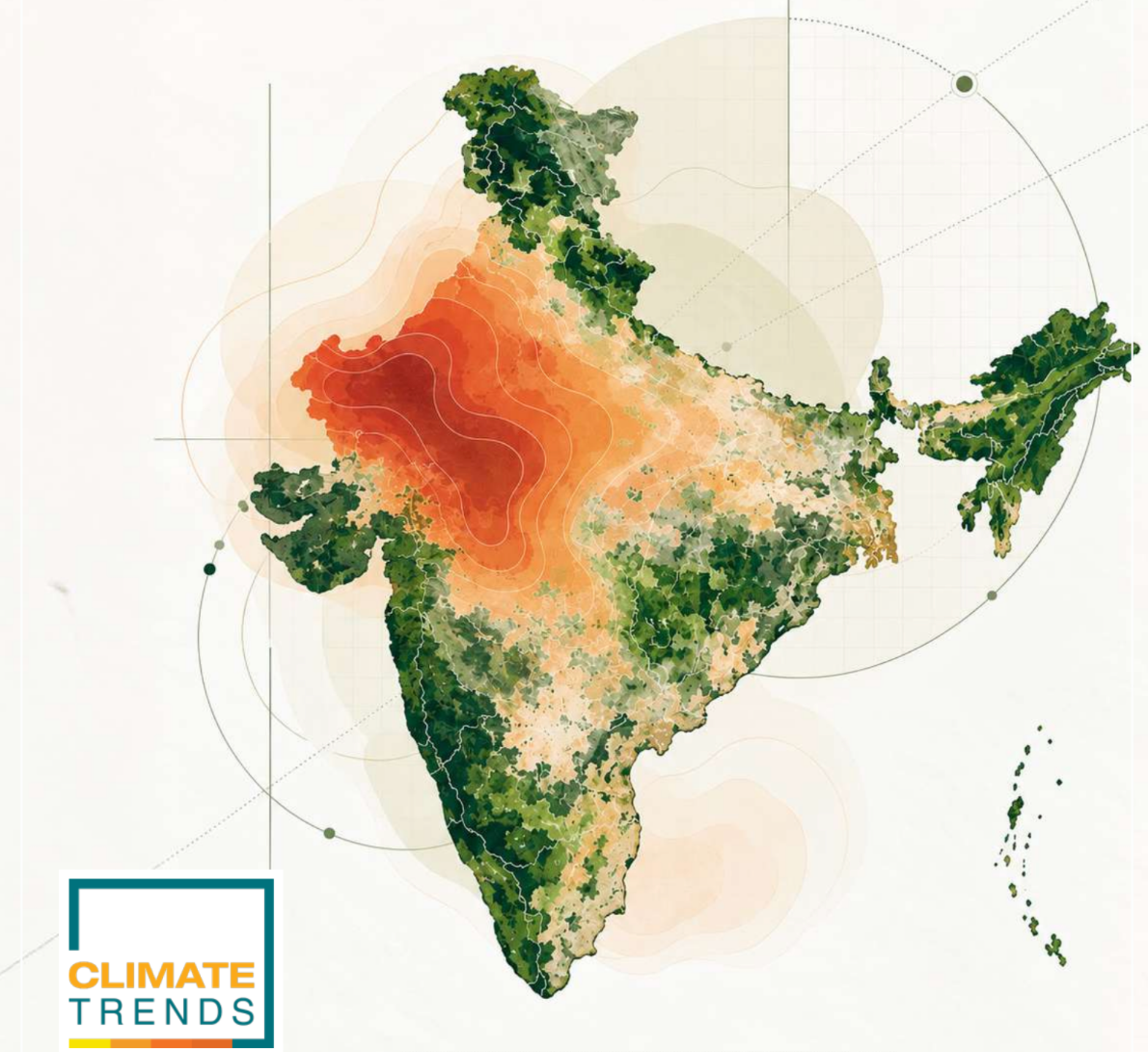


The study, ‘Assessment of Green Cover Dynamics and Their Influence on Summer Temperature across India Using MODIS Land Cover and ERA5 Reanalysis Data”, showed a substantial 5.6% decline in green cover between 2001 and 2025. Green-cover area decreased from approximately 36.95 percent in 2001 to 31.35 percent in 2025. Correspondingly, non-green land increased from 63.05 percent to 68.65 percent, indicating continuous expansion of anthropogenic and sparsely vegetated surfaces across large parts of the country.
Non-green surfaces remained warmer than green-covered areas throughout, between 2001 and
2025. The average summer temperature difference between the two land-cover categories ranged from approximately 1-2.5°C, highlighting the important role of green areas in regulating land-surface thermal conditions through evapotranspiration, shading, and enhanced surface moisture availability.
Dr Palak Balyan, Research Lead, Climate Trends said, “The findings clearly demonstrate that vegetation is not merely an ecological asset; it is an important component of India’s climate-adaptation infrastructure. The persistent 1-2.5°C summer temperature difference between green and non-green landscapes highlights the role of vegetation in regulating local thermal conditions through evapotranspiration, shading and moisture retention. Protecting existing natural vegetation should therefore be treated as an adaptation priority, particularly in regions experiencing simultaneous green-cover loss and rising summer temperatures.”
The analysis revealed distinct thermal responses, emphasizing the importance of conserving and restoring vegetation for climate adaptation and sustainable land management. Non-green landscapes consistently exhibited higher summer temperatures than vegetated areas.
Key highlights:
- Green-cover loss exhibits summer temperature increase: Areas experiencing green-cover loss exhibited a mean summer temperature increase of 0.26°C, indicating that conversion of vegetated land to non-green surfaces was generally associated with warming.
- Consistent lower temperatures in green regions: Although both land-cover categories exhibited warming over time, green-covered regions consistently maintained lower temperatures than surrounding non-green landscapes.
- Influence on overall temperature distribution across India: Vegetation not only reduces the average summer temperature but also influences the overall temperature distribution acrossIndia. Green-covered landscapes consistently provide a cooling effect relative to non-green surfaces throughout the study period.
- Pronounced regional variability: There was pronounced regional variability in summer temperature change. Warming was particularly evident across northwestern and northern India, while localized cooling occurred over parts of central and southern India.
- Green-cover loss spatially heterogenous: Land-cover transitions were spatially heterogeneous across the country. Green-cover loss was predominantly observed across western India, the Indo-Gangetic Plain, parts of central India, and several regions of peninsular India. In contrast, localized green-cover gains were identified in portions of the northeastern states, the Himalayan foothills, and scattered areas of southern and eastern India.
- Combined influence with regional climate warming: Temperature changes are governed by the combined influence of regional climate warming and local land-cover dynamics rather than by land-cover transition alone. Vegetation alone cannot completely offset the influence of large-scale climate change, but it remains an important natural mechanism for reducing local thermal stress.
- Dr S K Dhaka, Professor, Atmospheric Physics, Delhi University said, “Vegetation restoration can reduce local thermal stress, but it should not be viewed as a substitute for broader climate action. The warming observed even within areas that remained continuously green shows that large-scale climatic forcing continues to influence regional temperatures. India therefore needs a dual strategy: prevent further loss of established vegetation while implementing scientifically targeted restoration in heat-vulnerable regions, alongside stronger action on water management, urban planning and greenhouse-gas emissions.”
As meteorologists and scientists predict a repeat of 2024 summer in India with the strongest El Nino building in the Pacific since 1950, five states have already declared drought and the rest of the country is staring at a harsh and dry winter and 2027. While August was recorded as the warmest ever since 1901, monsoon performed 12.6 percent below average, with extreme spatial variability.
The International Labour Organisation and think-tank CEEW project that if warming trends continue, India will face a 4.5 percent reduction in GDP by 2030, equivalent to losing the working capacity of 35 million full-time jobs.
Aarti Khosla, Founder-Director, Climate Trends, said, “The study puts a number on something we’ve long argued, that vegetation is not a biodiversity afterthought, but a climate-adaptation infrastructure. Where green cover has disappeared, temperatures have risen with it, and that is a cost India’s communities are already paying for. The UNEP Emissions Gap report 2026 has just confirmed that overshooting 1.5°C degrees is now unavoidable, and named deforestation as one of the places the world is furthest behind. Governments meeting this month at CBD COP17 in Yerevan have been told that fewer than half their biodiversity targets, including the commitment to restore 30 percent of degraded ecosystems by 2030, are on track. India’s own green cover numbers show why that gap matters at home.and protecting green cover is not just about preserving biodiversity but also about keeping our landscapes cooler and our communities more resilient.”