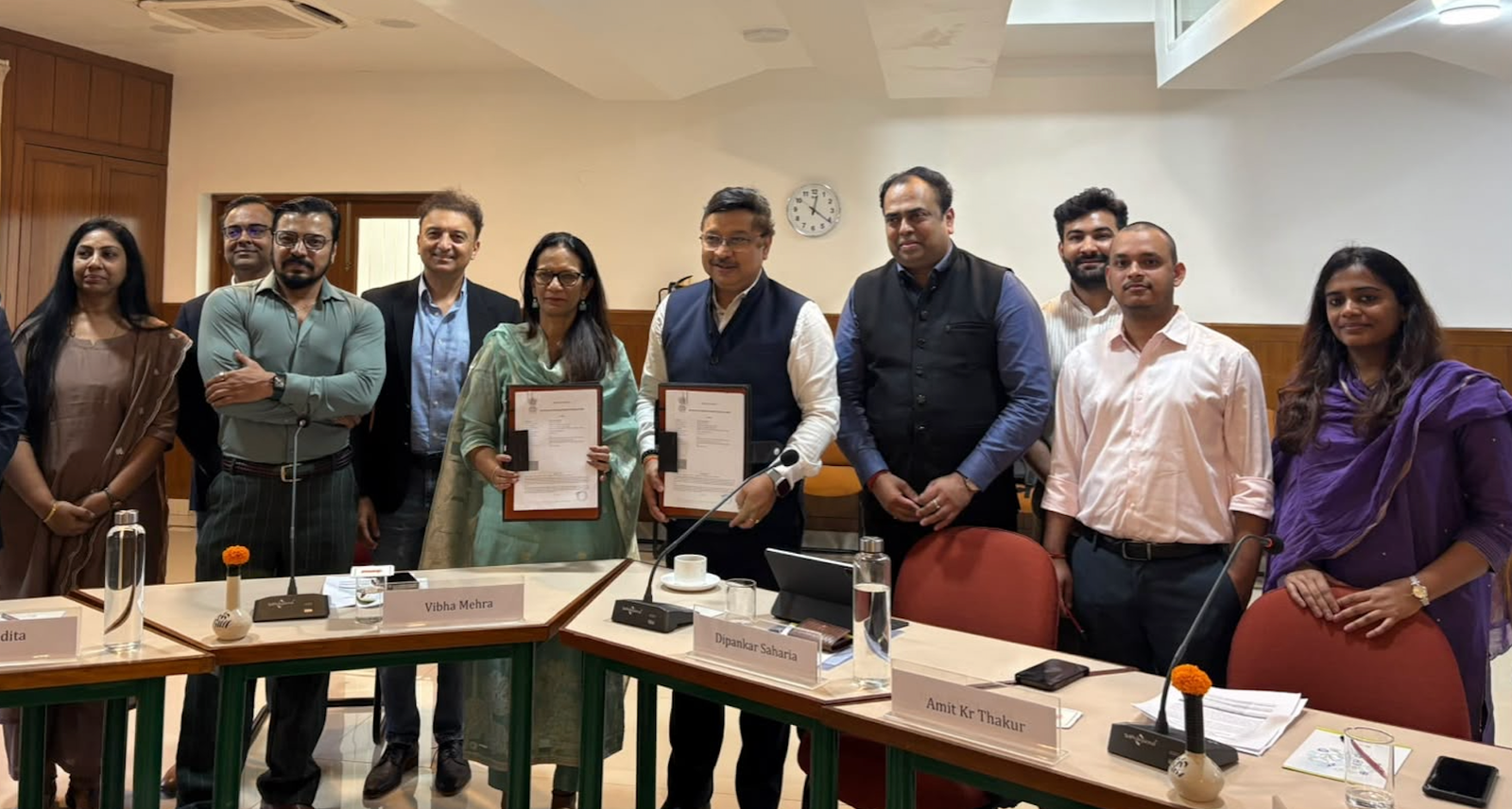


New Delhi: The Energy and Resources Institute (TERI) and Nokia India today formalised their partnership for the Nokia Pond Rejuvenation Project, by signing a Memorandum of Understanding (MoU) at a ceremony held at TERI Gram, Gwal Pahari. The MoU was signed by Dr Dipankar Saharia, Executive Director, TERI, and Vibha Mehra, Country Manager, Nokia, in the presence of leadership from both organisations.
Supported by the CSR vision of Nokia India, the project will rejuvenate 10 ponds in the district of Rewari, Haryana, with the objective of strengthening water security for domestic and agricultural use. Haryana is one of the country’s leading states in agricultural production and industrialisation yet continues to face perpetual water stress. As part of the ecological restoration effort, plantation activities will be carried out around the ponds, with strong engagement of local communities.
The ceremony began with a welcome address by Dr Dipankar Saharia, Executive Director, TERI, followed by a special address by Ms Vibha Mehra, Country Manager, Nokia India.
Dr Dipankar Saharia, Executive Director, TERI, said, “TERI and Nokia are united in their vision to deliver sustainable, scientific solutions that address pressing climate challenges and strengthen community resilience. This unique collaboration establishes a real ecosystem for community-led conservation, securing vital water resources for community and agricultural use. Beyond water security, the project actively enriches the region through enhanced green cover, protected livelihoods, and a renewed sense of community cohesion.”
Vibha Mehra, Country Manager, Nokia India, highlighted, “At Nokia, we believe lasting impact begins with empowering communities and supporting sustainable development at the grassroots level. Through our partnership with TERI, we are helping strengthen water security, restore local ecosystems, and create shared community assets that can benefit generations to come. As part of Nokia’s global sustainability commitment, we strive to create a positive impact for people and the planet by strengthening communities and supporting environmental resilience. We are proud to contribute to building a more resilient and sustainable future in Haryana.”
Plantation at TERI Gram
To mark the occasion, the dignitaries and attendees took part in a plantation activity at the Rose Garden in TERI Gram, a 100-acre green research campus in Gwal Pahari, symbolising the ecological restoration that the project will bring to the ponds of Rewari.
About the project
The Nokia Pond Rejuvenation Project is a natural resource management and ecological restoration programme being undertaken by TERI in Haryana. It combines the revival of village ponds with plantation drives around them, to improve water availability for households and farms while restoring local ecosystems. The partnership is built on the shared belief that grassroots-level action can contribute meaningfully to India’s larger objectives of sustainable development.
The initiative also aligns with the global sustainability commitment at Nokia to create a positive impact for people and the planet by strengthening communities, supporting environmental resilience, and improving water security.
Key highlights
- Rejuvenation of 10 ponds in Rewari district, Haryana
- Focus on water security for domestic and agricultural use
- Plantation activities around the ponds to support ecological restoration
- Active engagement of local communities
- Key targets of the project, spanning 24 months include:
- Conservation of 1,20,000 cubic meters of water conserved with enhancement of water storage capacity to 120 million litres;
- Plantation of 200 native species to enhance green cover;
- Installation of 100 streetlights to eliminate dark zones and enhance safety;
- Installation of benches and dustbins to create a community recreational space around the ponds;
- Direct benefits to around 22,000 people (as per Census, 2011) with indirect beneficiaries of around 50,000 people benefitting from the impacts created by water conservation and recharge, and ecological restoration.