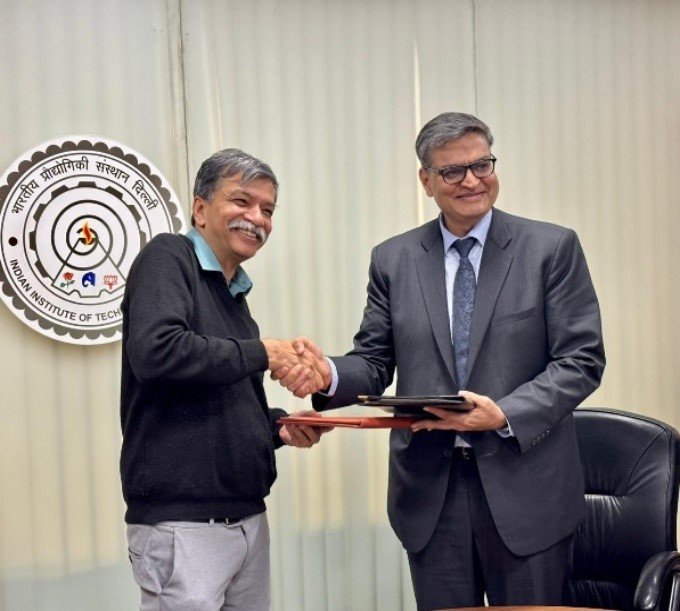


New Delhi: The International Solar Alliance and the Indian Institute of Technology Delhi on February formalised a Framework for Action (FFA) to strengthen cooperation in advancing renewable energy, with a strong focus on capacity building, academic collaboration, and human resource development across ISA Member Countries. The partnership will support the training of renewable energy engineers, Solar Technology Application Centre (STAR-C) trainers, and research professionals, while promoting joint research, knowledge exchange, and technology cooperation in the field of solar energy.
The MoU has been signed by Ashish Khanna, DG, ISA and Prof. Rangan Banerjee, Director, IIT Delhi.
Prof. Vivek V. Buwa, Deputy Director (Strategy & Planning), IIT Delhi; Prof. Dhanya C. T., Dean, Academics, IIT Delhi; Prof. Somnath Baidya Roy, Dean, Planning, IIT Delhi; Prof Nilanjan Senroy, Dean, Alumni Relations, IIT Delhi; Mr. Felipe Saliba, Chief of Unit KMID, ISA; Prof. Ramesh Narayanan, Head of Department, Energy Science and Engineering [DESE], IIT Delhi; and other dignitaries from IIT Delhi and ISA were present on this occasion.
The Framework marks a significant milestone and builds on ongoing capacity building efforts between ISA and IIT Delhi’s Department of Energy Science and Engineering which to date has successfully supported M. Tech. programme for professionals in Renewable Energy Technologies and Management, from across 18 developing countries across Africa and Asia Pacific.
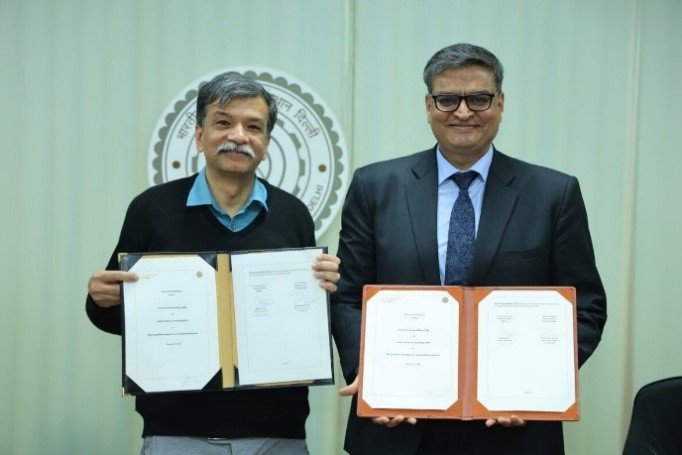
Speaking on the occasion, Director General of the International Solar Alliance, Ashish Khanna, said, “Over the last five years, over a hundred students undertook masters in renewable energy through our partnership with the Indian Institute of Technology Delhi where they are now taking on leadership roles across Africa, SIDS, and neighbouring regions, driving solar deployment and energy access where it is needed most. Building on this strong foundation, we are now expanding this partnership to launch a one year post graduate Diploma programme based on a Train-the-Trainers model. Leveraging IIT Delhi’s extensive academic network, and in collaboration with Institut National de l’Énergie Solaire (France), this initiative will help establish a global framework for building clean energy capability across International Solar Alliance Member Countries. Looking ahead, we are also exploring the expansion of existing Master’s opportunities to include Master’s programmes in Public Policy and Ph.D. – solar energy sector pathways, further deepening academic collaboration and strengthening the global clean energy talent pipeline. This has the potential to transform the human capability on solar energy in Global South countries.”
Prof. Rangan Banerjee, Director, IIT Delhi, said, “We are delighted to sign this agreement with ISA to develop global capacity in solar and renewable energy. This will benefit the Global South and India to build a sustainable pathway to net zero. We will be incorporating the latest techniques of AI, ML and Blockchain to enhance distributed solar and ensure security in future sustainable energy systems. ”
Under the Framework for Action, ISA and IIT Delhi will collaborate across four core areas:
- Capacity Building and Talent Development
Building a robust global talent pipeline by training Solar Technology Application Resource-Centre (STAR-C) trainers from across ISA Member Countries. - Academic Programmes
Expanding collaboration beyond the flagship M. Tech in Renewable Energy Technologies & Management to include the Train the Trainers (ToT) programme, a Master’s in Public Policy, and a Ph.D. in Solar Energy sector, shaping the next generation of clean energy leaders. - Joint Research and Knowledge Creation
Advancing research in solar resource assessment, quality standards, emerging technologies, and innovative applications, supported by shared teaching tools, knowledge products, and research outputs. - Outreach and Knowledge Exchange
Co-hosting workshops, seminars, and outreach activities to deepen collaboration and strengthen the global solar knowledge ecosystem.
The partnership reinforces a shared commitment to building long-term capability for the global solar transition.