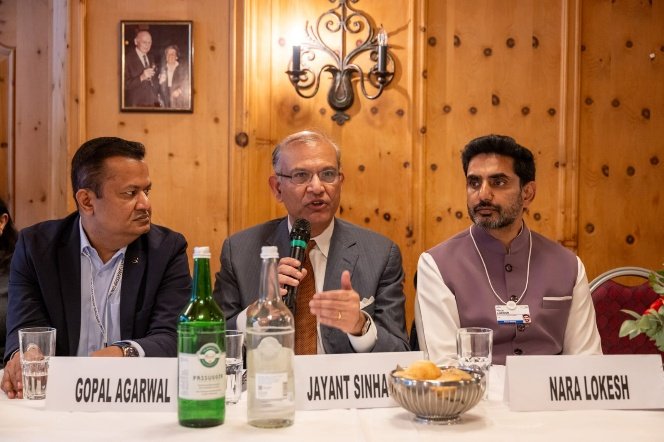


Greater Noida: At the World Economic Forum in Davos, global leaders convened for a compelling exchange of ideas on the future of business and society. Gopal Agrawal, CEO of Anupam Rasayan India Limited, one of India’s leading custom synthesis and speciality chemical players, participated in an insightful lunch dialogue hosted by the Confederation of Indian Industry (CII), highlighting the growing centrality of sustainability as a strategic differentiator for businesses.
The high-level discussion brought together senior policymakers and industry leaders, including Pralhad Joshi, Union Minister for New & Renewable Energy and Consumer Affairs; Harsh Sanghavi, Deputy Chief Minister of Gujarat; Lokesh Nara, Minister for IT, Government of Andhra Pradesh; and Jayant Sinha, former Union Minister of State for Finance and Civil Aviation. The deliberations focused on the pivotal role of sustainability in shaping global competitiveness and long-term economic resilience.
Speaking during the interaction, Agrawal emphasized, “While Anupam Rasayan has built its reputation over the last 40 years on quality and reliability, sustainability has increasingly become our ‘hook to win’ in global markets. Customers today are not only evaluating products and pricing, but also the values and long-term commitments of their partners.”
He further shared the company’s strides in implementing its sustainability roadmap: nearly two-thirds of Anupam Rasayan’s current energy requirements are already met through green sources, and the company is committed to transitioning to 100% renewable energy by 2027. A key milestone in this journey came in 2023, when Anupam Rasayan signed three Memorandums of Understanding (MoUs) with the Government of Gujarat for afforestation on 150 hectares across Narmada, Tapi, and Surat districts—aiming to plant over 1,66,000 trees as part of the state’s Green Belt Development Drive to offset carbon emissions and support net-zero goals.
Highlighting a broader national perspective, Agrawal stated, “If sustainability is embedded at the state and national level, India can position itself as a preferred global manufacturing destination, driving investments, strengthening supply chains, and enabling long-term economic growth.”
Platforms like WEF reinforce that sustainability is no longer a choice but a strategic imperative—one that requires collaboration between industry and policymakers to accelerate transitions, foster innovation, and build a resilient, future-ready India. As Agrawal aptly concluded, “Sustainability is not just good ethics; it is good business. Those who integrate it into their strategy today will lead tomorrow’s global economy.”