

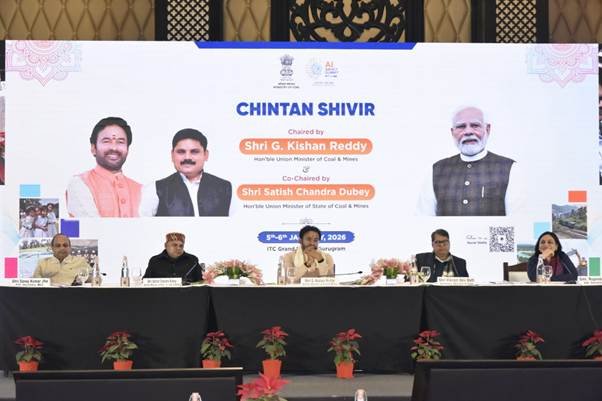
Greater Noida: The Ministry of Coal organized a two day-long Chintan Shivir on 5th&6th January, 2026 at Manesar, Gurugram, under the chairmanship of the Union Minister of Coal and Mines, G. Kishan Reddy, and co-chaired by the Minister of State for Coal and Mines, Satish Chandra Dubey. The Chintan Shivir was attended by Vikram Dev Dutt, Secretary, Ministry of Coal, Rupinder Brar, Additional Secretary, Sanoj Kumar Jha, Additional Secretary, Chairman, Coal India Limited, CMDs of all Coal/Lignite Public Sector Undertakings along with senior officers of the Ministry of Coal. The forum enabled senior leadership of the coal ecosystem to move beyond routine administration and engage in focused, outcome-oriented deliberations on reforms, performance, and institutional transformation.
The Chintan Shivir was convened as a strategic platform to review the progress of ongoing reforms in the coal sector and to deliberate on a forward-looking roadmap aligned with India’s long-term energy security and developmental priorities
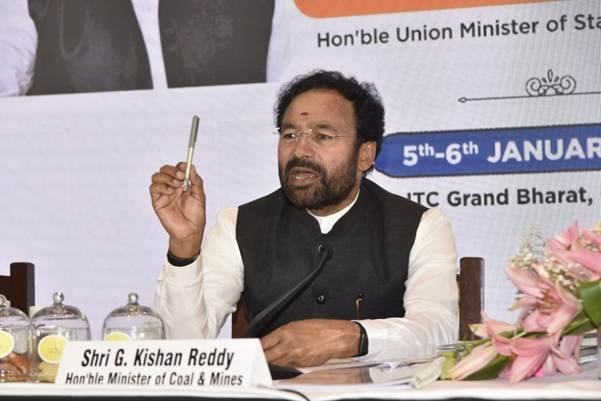
Delivering the keynote address, G. Kishan Reddy, Union Minister of Coal and Mines, emphasized that coal continues to remain an indispensable pillar of India’s energy security, even as the country steadily advances its clean energy transition. He stated that coal provides reliable base-load power, supports critical industries such as steel and cement, and plays a vital role in sustaining economic growth and national development.
The Union Minister highlighted that FY 2024–25 marked a historic milestone, with India achieving its highest-ever coal production of over 1,047MT. This achievement, he noted, reflects sustained capacity creation, improved operational efficiency, and strong coordination across the coal value chain.
Union Minister Reddy emphasized that reforms across the coal sector must be anchored in uniformity and standardization, ensuring consistent practices, clear benchmarks and predictable outcomes across all Coal PSUs. He called for the charting of a focused, time-bound plan to maximize equipment utilization, improve asset productivity and reduce operational inefficiencies through better planning and monitoring. Underscoring that safety remains non-negotiable, the Minister stressed the need for rigorous safety norms, strengthened supervision and accountability, with the clear objective of achieving zero accidents. He further highlighted that operational growth must be accompanied by deepened community welfare initiatives, focusing on health, education and livelihood support in coal-bearing regions. Reiterating the sector’s environmental responsibilities, the Minister underlined the importance of systematic afforestation and ecological restoration, integrating sustainable practices into mining operations to ensure balanced and responsible development.
He further observed that steady growth in domestic production and improved logistics have led to a significant reduction in coal imports, particularly for blending purposes, resulting in substantial foreign exchange savings. He noted that India is now approaching a stage where domestic availability is increasingly meeting national demand, placing the country on the threshold of selectively exploring coal exports, while fully safeguarding domestic requirements. This transition, he stated, reflects growing confidence in India’s production capacity, quality improvements, and supply-chain resilience.
Highlighting key policy and operational priorities, the Union Minister emphasized the imperative of safeguarding energy security, strengthening logistics and supply-chain resilience, improving coal quality, accelerating technology adoption, and reinforcing community care through responsible and people-centric development initiatives. The Minister urged that the outcomes of the Chintan Shivir must be taken to all levels of the organisations to ensure faster and coordinated execution. He called upon Coal PSUs to decisively move from deliberation to delivery and to establish higher benchmarks in productivity, safety, sustainability, innovation, and community engagement, underscoring that consistent execution and measurable outcomes must define the next phase of the coal sector’s transformation.
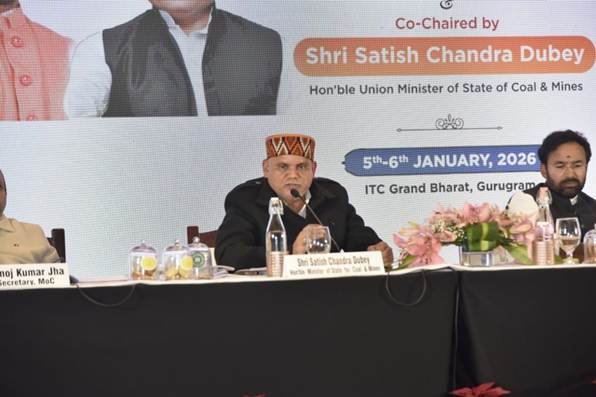
Addressing the gathering, Satish Chandra Dubey, Minister of State for Coal and Mines, stated that the Chintan Shivir reflects the Ministry’s commitment to long-term, outcome-oriented governance and collective vision-building. He reaffirmed that coal continues to play a vital role in India’s energy mix by ensuring stability and reliability as the country expands renewable energy capacity and pursues its climate commitments. Dubey emphasized the need for a sharper focus on strengthening washery capacities to ensure consistent improvement in coal quality and to better meet consumer requirements. He underlined that clear accountability must be institutionalized, with a designated responsible officer deployed for monitoring each mine block to ensure timely execution, operational discipline and adherence to prescribed standards. The Minister also stressed the importance of expediting First Mile Connectivity projects, noting that faster mechanization and seamless evacuation are critical for improving logistics efficiency, reducing handling losses and enhancing the overall competitiveness of the coal sector.
Dubey highlighted improvements in coal availability at power plants, reduction in coal imports leading to significant foreign exchange savings, enhanced logistics efficiency, and increasing contributions from captive and commercial coal blocks. He also emphasized the growing role of digital platforms and technology-driven solutions in improving operational efficiency, safety standards, and service delivery to coal workers. Dubey urged CMDs and leadership teams of Coal PSUs to focus on speed, scale, and consistency in execution, ensuring that reforms translate into tangible and measurable outcomes on the ground.
In his opening remark, Vikram Dev Dutt, Secretary, Ministry of Coal, stated that the coal sector has reached a stage where policy clarity, institutional reforms, and enabling frameworks are firmly in place, and the focus must now shift decisively to delivery, discipline, and measurable outcomes. He emphasized that with delegation of powers, decentralization of approvals, and simplification of processes already implemented, there is no justification for delays or underperformance.
The Secretary stressed that the coming phase demands speed with accountability, with every CMD and senior executive taking complete ownership of targets, timelines, and results. Performance, he stated, will be assessed on time-bound delivery and on-ground impact, not on intent alone. He directed that exploration, mine operationalization, logistics coordination, and project execution must be pursued with a results-first approach. Dutt asserted that technology adoption is non-negotiable, and that digital systems, real-time monitoring, AI-enabled platforms, and data-driven decision-making must become standard operating practice across the coal value chain.
He further emphasized that environmental responsibility, mine reclamation, sustainability, and social accountability are integral to operational excellence and must be embedded into planning and execution. Further, he stated that this Chintan Shivir must mark a clear shift from reform discussion to a reform-driven performance culture, with a strong focus on execution and measurable outcomes.
The Chintan Shivir featured a series of structured thematic sessions addressing critical operational and strategic dimensions of the coal sector. A session on Reforms Planned, moderated by B. Sairam, Chairman, Coal India Limited, focused on the reform agenda aimed at strengthening performance and steering the coal sector through a market-driven transition. The presentation underscored that reforms must fundamentally transform systems to deliver sustained performance. Key measures included modernization of Fuel Supply Agreements with customer-centric provisions, clearly defined KPIs for assured delivery and coal quality consistency, and the use of AI-enabled tender evaluation to minimize bias, standardize scoring, flag red-flags, and ensure faster closure with fewer disputes. Structural and governance reforms were also highlighted, including the creation of a dedicated land acquisition cadre for effective rehabilitation and stakeholder management, updation and delegation of powers to remove ambiguities and simplify approval hierarchies, and a unified recruitment manual to codify recruitment rules, benchmark practices with industry standards, and shorten hiring cycles. The session further emphasized digital transformation through integrated connect–automate–protect frameworks, strengthening of the R&D ecosystem, and modernization of exploration and mine planning. Collectively, these reforms aim to reform systems, transform operations, and enhance market-oriented performance across the coal sector. This was followed by a session on Cost Optimization in Operations, which deliberated on productivity enhancement and operational efficiency across Coal PSUs.
A dedicated session on Speeding Up Exploration, moderated by senior leadership of CMPDI, examined strategies to accelerate exploration timelines and strengthen geological preparedness. The session on Early Operationalization of Mines, moderated by Ms. Rupinder Brar, Additional Secretary, Ministry of Coal, along with senior technical officers, focused on expediting statutory clearances and ensuring timely commencement of mining operations.
Further sessions on Coal Quality Improvement, Underground Mining, and Competitiveness with Commercial Mining, moderated by CMD-level and senior technical leadership of Coal India Limited, addressed beneficiation, advanced mining technologies, safety practices, and strategies to enhance competitiveness of Coal PSUs in the evolving mining landscape. Each session was followed by interactive deliberations aimed at identifying bottlenecks and evolving actionable solutions.
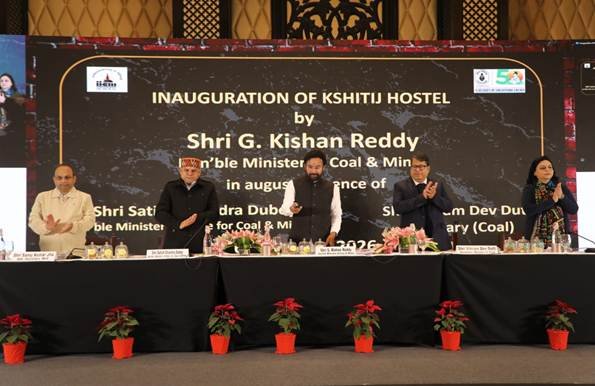
During the Chintan Shivir, the Union Minister for Coal and Mines, G Kishan Reddy, inaugurated the newly constructed Executive Hostel at the Indian Institute of Coal Management (IICM), Ranchi. The state-of-the-art facility is designed to enhance residential and training infrastructure for senior executives and officers of the coal sector, strengthening IICM’s role as a premier institution for capacity building, leadership development and knowledge-driven institutional excellence in the coal and mining ecosystem.
The deliberations held during the Chintan Shivir underscored the need to convert discussions into focused implementation, disciplined execution, and clearly measurable outcomes across the coal ecosystem.
The Ministry of Coal reiterated its commitment to providing strategic direction and institutional support, while emphasizing accountability and timely delivery at every level.
Earlier, on 5 January, a focused presentation and discussion on enhancing competitiveness in the context of commercial coal mining was held, moderated by the Chairman, Coal India Limited, providing insights into performance benchmarking, productivity improvement and strategic preparedness in an evolving mining landscape.
As India moves steadily towards the vision of Viksit Bharat by 2047, the coal sector stands at a defining phase, characterized by enhanced domestic capacity, operational resilience, and increasing competitiveness. With clarity of direction, collective responsibility, and a performance-oriented approach, the coal sector is well -positioned to reinforce national energy security, strengthen self-reliance, and contribute responsibly to the country’s long-term growth as a future-ready and sustainable energy sector.
Read more on X:
https://x.com/CoalMinistry/status/2008406826958885248/photo/1
https://x.com/kishanreddybjp/status/2008508634935030198/photo/1
https://x.com/satishdubeyy/status/2008434606085992807/photo/1