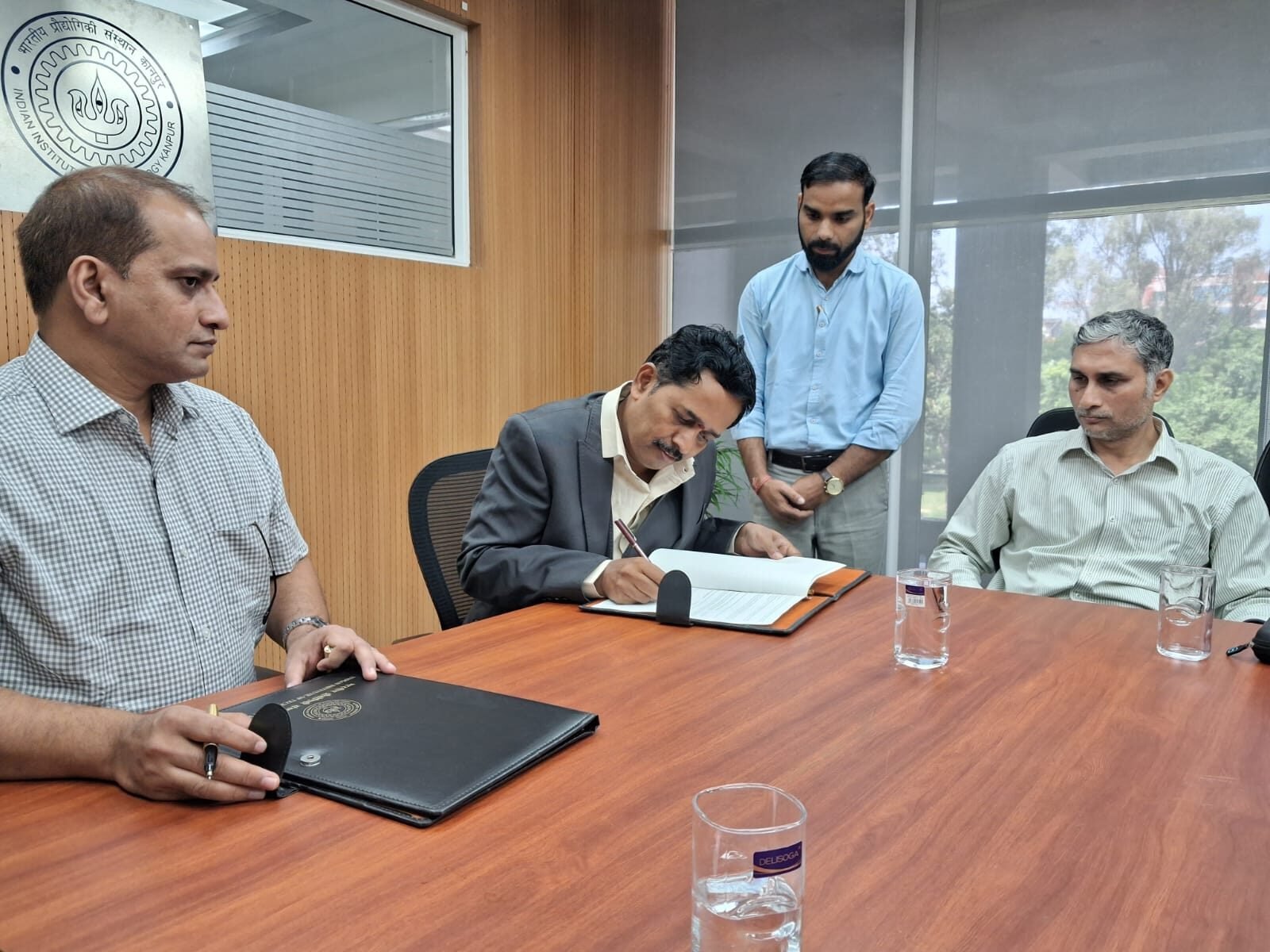


New Delhi: IIT Kanpur has signed a Memorandum of Understanding with Bengaluru-based NexPV Energy Systems facilitated by Invariance Automation, a member company of IIT Kanpur’s Research and Technology Park Foundation (Technopark@iitk), to design and develop India’s first Sun Simulator for Concentrated Photovoltaic (CPV) systems. The facility will enable CPV modules to be tested and characterised at the end of production lines in India, a capability that does not currently exist in the country.
The project is led by Professor Ashish Garg and team from IIT Kanpur’s Department of Sustainable Energy Engineering. It reflects the Institute’s research focus on clean energy technologies that can move from laboratory to large-scale manufacturing. It also advances Technopark@iitk’s mandate of building industry-academia partnerships around indigenous innovation.
Prof. Ashish Garg, Department of Sustainable Energy Engineering, IIT Kanpur, said, “India’s net-zero commitment for 2070 will require solar deployment at a scale far beyond today’s, and that growth must rest on domestic capability across the value chain. Testing infrastructure is a strategic part of that chain: a technology cannot scale if it cannot be measured reliably. CPV modules behave fundamentally differently from flat panels, and building India’s first simulator designed for them is exactly the kind of translational research IIT Kanpur is committed to.”
CPV systems use optical lenses to concentrate sunlight onto tiny, ultra-efficient multi-junction cells. These cells stack several semiconductor layers, each capturing a different part of the solar spectrum. The cells occupy only about 0.1% of the panel area, cutting cell requirement by more than 99% compared with conventional solar panels. NexPV, led by Mr Chidananda Murthy R, has developed indigenous CPV technology. Its proof-of-concept systems have operated in the field for around three years, and the company is moving to large-scale manufacturing.
Chidananda Murthy R, Director, NexPV Energy Systems, said, “India has crossed 168 GW of installed solar capacity, but domestic cell manufacturing remains well behind module capacity, and with the cell mandate now in force, that gap directly affects deployment. CPV needs less than one per cent of the cell area of a conventional panel and, in our systems, about half the land. It can open a new pathway for solar in India’s high-DNI regions. A domestic CPV simulator gives us the quality assurance to manufacture at scale.”
Existing sun simulators are designed for flat-plate panels. CPV modules work only with direct, parallel sunlight, accept light within a very narrow angle, and are sensitive to spectral balance. The IIT Kanpur team will engineer a simulator that reproduces these conditions precisely. In future Invariance Automation will serve as the preferred manufacturing partner to take the system from prototype to production.