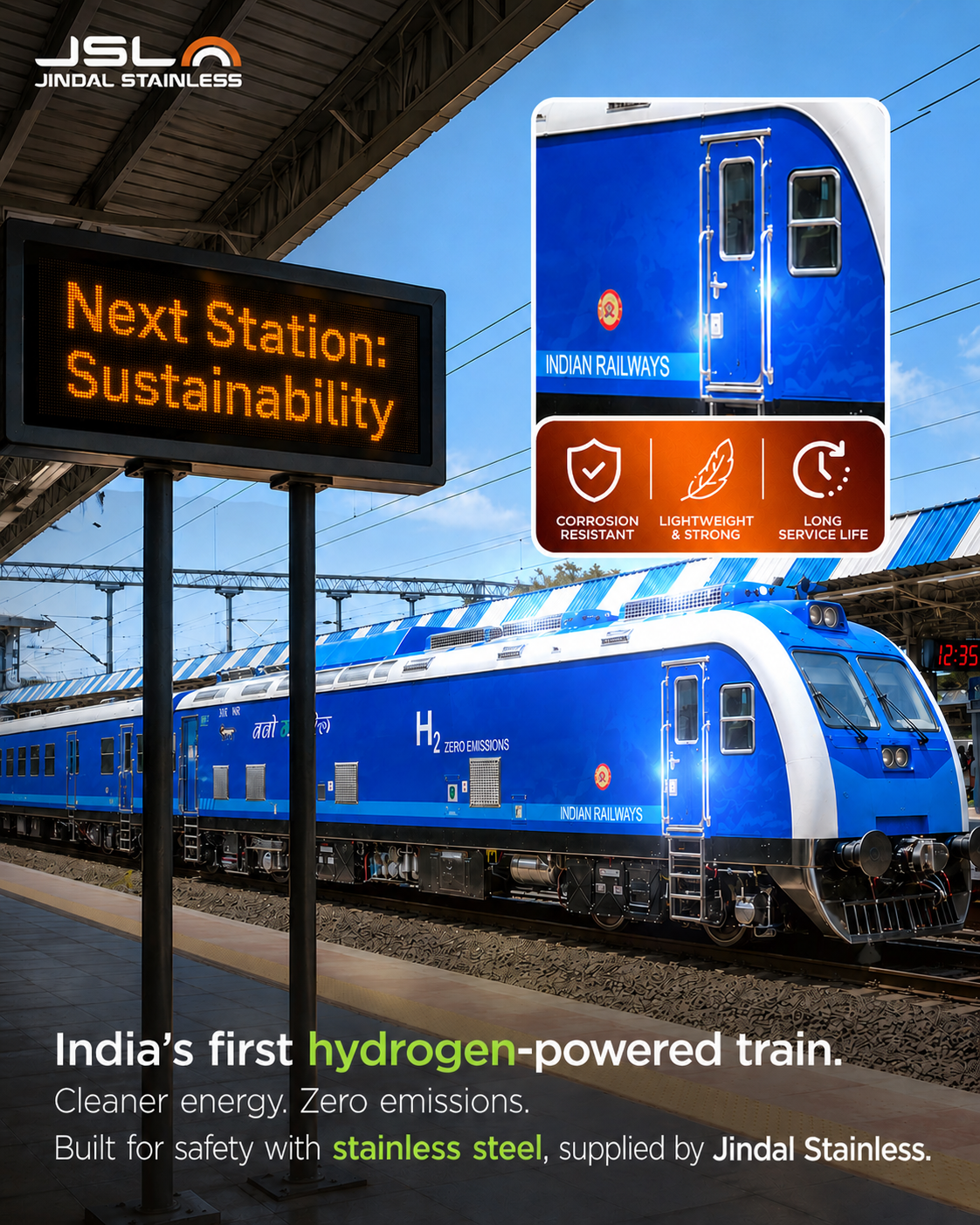


NEW Delhi: Reinforcing its contribution to India’s next generation of sustainable mobility, Jindal Stainless, India’s leading stainless steel manufacturer, has supplied about 40% of the total stainless steel requirement for India’s first hydrogen-powered train.
The premium austenitic stainless steel grade X5CrNi1810, exclusively supplied by Jindal Stainless’ Jajpur and Hisar plants, has been used in the fabrication of the hydrogen train. Equipped with a hydrogen propulsion system, the train represents a significant step in Indian Railways’ efforts towards adopting green mobility solutions.
Stainless steel has emerged as the preferred material for modern railway coaches owing to its unique combination of corrosion resistance, crash-worthiness, high strength-to-weight ratio, fire and impact resistance, durability, and recyclability. Its lightweight properties also contribute to improved energy efficiency, making it particularly well-suited for emerging mobility solutions such as hydrogen-powered trains.
Abhyuday Jindal, Managing Director, Jindal Stainless, “The future of mobility will be defined not only by cleaner sources of energy but also by advanced materials that make these technologies more efficient, durable and sustainable. We are proud to contribute to India’s first hydrogen-powered train, an important milestone in the country’s clean mobility journey and its vision of Atmanirbhar Bharat. Stainless steel has consistently demonstrated its value in railway applications through its strength, corrosion resistance, safety and lifecycle performance. As India accelerates the development of next-generation transport infrastructure, we remain committed to delivering material solutions that enable innovation, sustainability and long-term value.”
Jindal Stainless has been a supplier to Indian Railways for more than three decades, supplying stainless steel for several landmark projects, including the first LHB coaches, the Vande Bharat Sleeper, and India’s first Vande Metro train among other metro and inter-city train sets. The company is also a regular supplier of material to wagon bodies, including the country’s first corrosion-resistant stainless steel salt containers for freight transportation. The company’s growing contribution to advanced railway applications reflects the increasing adoption of stainless steel as the material of choice for safe, durable and sustainable transportation infrastructure.
Hydrogen-powered trains have the potential to play an important role in decarbonising rail transport globally by combining zero emissions with lower operating noise and improved energy efficiency. The use of lightweight, corrosion-resistant stainless steel further enhances these benefits by reducing lifecycle costs while improving operational performance.
The development further reinforces the growing role of stainless steel in shaping the future of transportation in India. From high-speed rail and metro systems to hydrogen-powered mobility, the metal continues to support infrastructure that delivers superior lifecycle performance, enhanced safety and lower environmental impact.