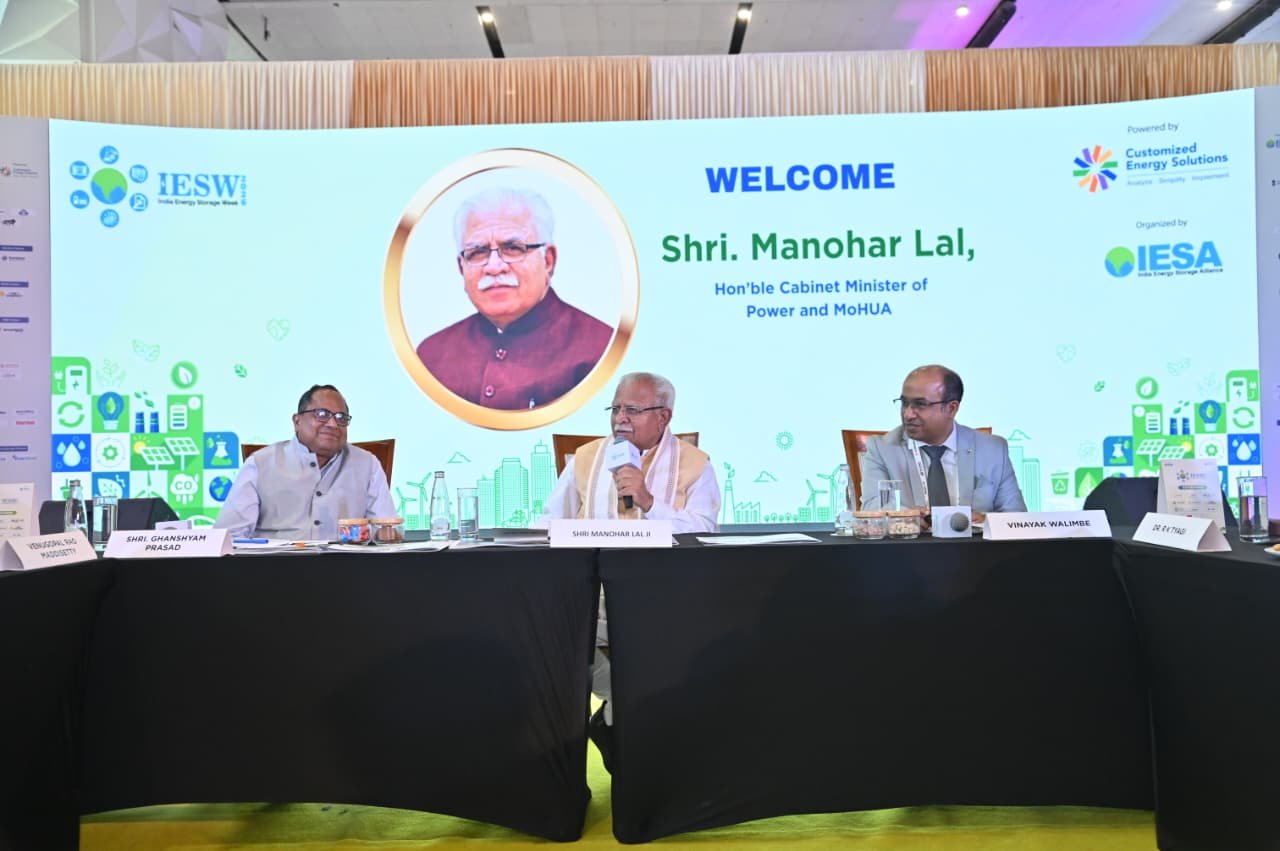


New Delhi: “India’s peak power demand is set to reach 300 gigawatts next year, driven by the rapid expansion of data centers, artificial intelligence, and electric vehicles,” said Manohar Lal, Hon’ble Union Minister for Power at the 12th India Energy Storage Week (IESW) 2026 at Yashobhoomi, New Delhi. The Minister highlighted, “According to estimates, we have already reached 271 GW and projections suggest the peak may rise even further this year. Our available capacity has grown up to 284 GW, which enables us to meet all types of demand. But with the accelerating pace of electrification, we must prepare for 300 GW peak demand next year. Our installed power generation capacity has grown from 249 GW in 2014 to 445 GW today, with solar capacity surging fifty-fold in twelve years to 137 GW. As our needs rise, energy storage becomes a national imperative, ensuring the power generated can be used whenever and wherever it’s needed,” he noted.
Reflecting on India’s energy journey, the Minister noted, “Energy is constant, but today, the principle is evolving, energy can be stored. While earlier, consumption happened instantly upon generation, now, through advanced storage and grid solutions, we can shift and utilize energy according to our needs.” He highlighted India’s leadership in pumped storage projects since 1923 and the growing importance of storage in bridging the gap between variable renewable generation and round-the-clock demand.
Manohar Lal further emphasized the country’s commitment to environmental reforms and net-zero carbon emissions by 2070, noting that non-fossil fuel capacity has soared from 81 GW to 291 GW in just over a decade. “Solar, which was just 3 GW twelve years ago, is now at 137 GW, a 50x growth. But as much as solar has grown, we must invest in storage to truly harness its potential, targeting peak hours and ensuring energy is available 24/7,” he said.
The Minister also underscored the necessity of indigenization and self-reliance: “Nothing is greater than the country. Even if domestic products cost more initially, they belong to India. By manufacturing within our borders, we reduce imports, lower costs over time, and secure our nation against global uncertainties. ‘Vocal for Local’ and ‘Make in India’ are crucial for our power sector, especially in solar cells, batteries, and containers.”
Touching on global collaborations, the minister referenced the ‘One Sun, One World, One Grid’ vision, highlighting India’s efforts to build transnational green energy corridors, including a proposed 1,600-kilometre undersea cable to the UAE with an estimated cost of ₹40,000 crore, and expansion plans for connections to Sri Lanka, Singapore, and even Europe. He emphasized, “As the world moves to green energy, India’s leadership in storage, manufacturing, and R&D will benefit not just the nation, but the world.”
The Minister applauded key government policy initiatives such as the ISTS charges waiver, streamlined building guidelines, Time of Day tariffs, and green open access rules, all designed to encourage renewable energy adoption, support market access for generators, and benefit consumers.