


The country’s present fiscal situation owes much to COVID-19. The pandemic caused an unprecedented spike in India’s public debt-to-GDP ratio (see chart below). While the government has aggressively trimmed its fiscal deficit in recent years, bringing the deficit down to 4.75 % of GDP in FY2024/25; public debt remains wel above the government’s ‘50% by 2031’ target. Assuming annual 10.5% growth in nominal GDP through 2031 as per official projections, we estimate New Delhi would need to start by budgeting a 4.3% deficit in the coming fiscal year in order to meet its medium-term debt target while minimising disturbances to economy activity.
Falling Fiscal Deficit Amidst Elevated Deb
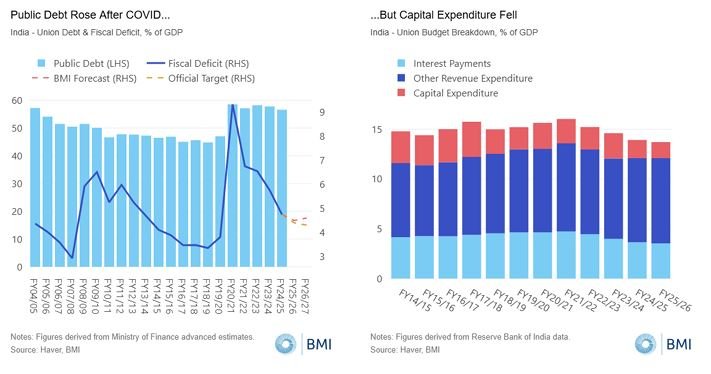
Yet, domestic economic aspirations and external political reality mean India faces fresh spending needs. The government has set a goal of India becoming a developed nation by 2041. This vision – commonly known as Viksit Bharat – will require public investments in infrastructure and support for small to medium-sized enterprises. Unfortunately, a side effect of past fiscal consolidation efforts was to reduce capital expenditure vis-à-vis GDP (see right chart above).
In this vein, Prime Minister Narendra Modi has recently announced a six year, INR1 trilion Research & Development fund. Also, investors expect around INR3trn to be alocated towards the railway sector in the upcoming budget according to the Hindustan Times on December 26. These and other measures to arrest the slide in public capital expenditure wil only raise the deficit.
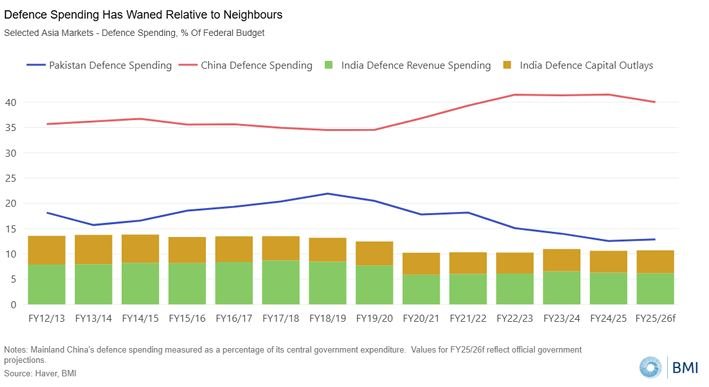
India’s more dangerous external environment also presents new spending needs. The country has engaged in armed conflict with the People’s Republic of China and Pakistan during the past five years. At the same time, defence spending as a share of central government expenditure has stagnated, after faling significantly during 2018-2020 (see chart below). China’s elevated defence spending levels, along with Pakistan’s recent decision to increase its defence budget mean New Delhi must consider spending more on security in FY2026/27.
The fresh spending needs would not necessarily entail greater public deficits if the government could generate more revenue. Unfortunately, India’s Goods & Services Tax and Income Tax reforms during 2025 will probably hurt tax revenues in the coming fiscal year. Moreover, Finance Minister Sitharaman has stated custom duties rationalisation wil be another area of focus for the coming union budget. If this much-needed rationalisation proceeds along the same lines as previous tax reforms, it wil probably further lower tax receipts. Hence, while we believe the government will target a 4.3% fiscal deficit for FY2026/27 in line with its fiscal consolidation agenda, we forecast the actual deficit equalling 4.6%.