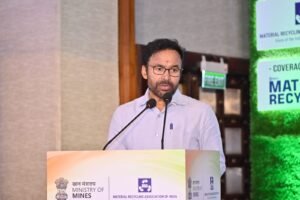


The Minister’s assurance came as MRAI highlighted the need for the Government to consider certain key issues such as immediate abolishment of the Pre-shipment Inspection Certificate (PSIC) framework that has almost brought the industry to a halt as its impacting the operations and other issues like removal of import duty on aluminium scrap and reforms in Extended Producers’ Responsibility (EPR), extending an industry status among others. The recycling industry urged that such policy reforms would strengthen India’s recycling industry, build domestic capabilities and a predictable policy environment and easier access to recyclable raw materials to also reduce dependence on primary mining and imports of critical minerals.
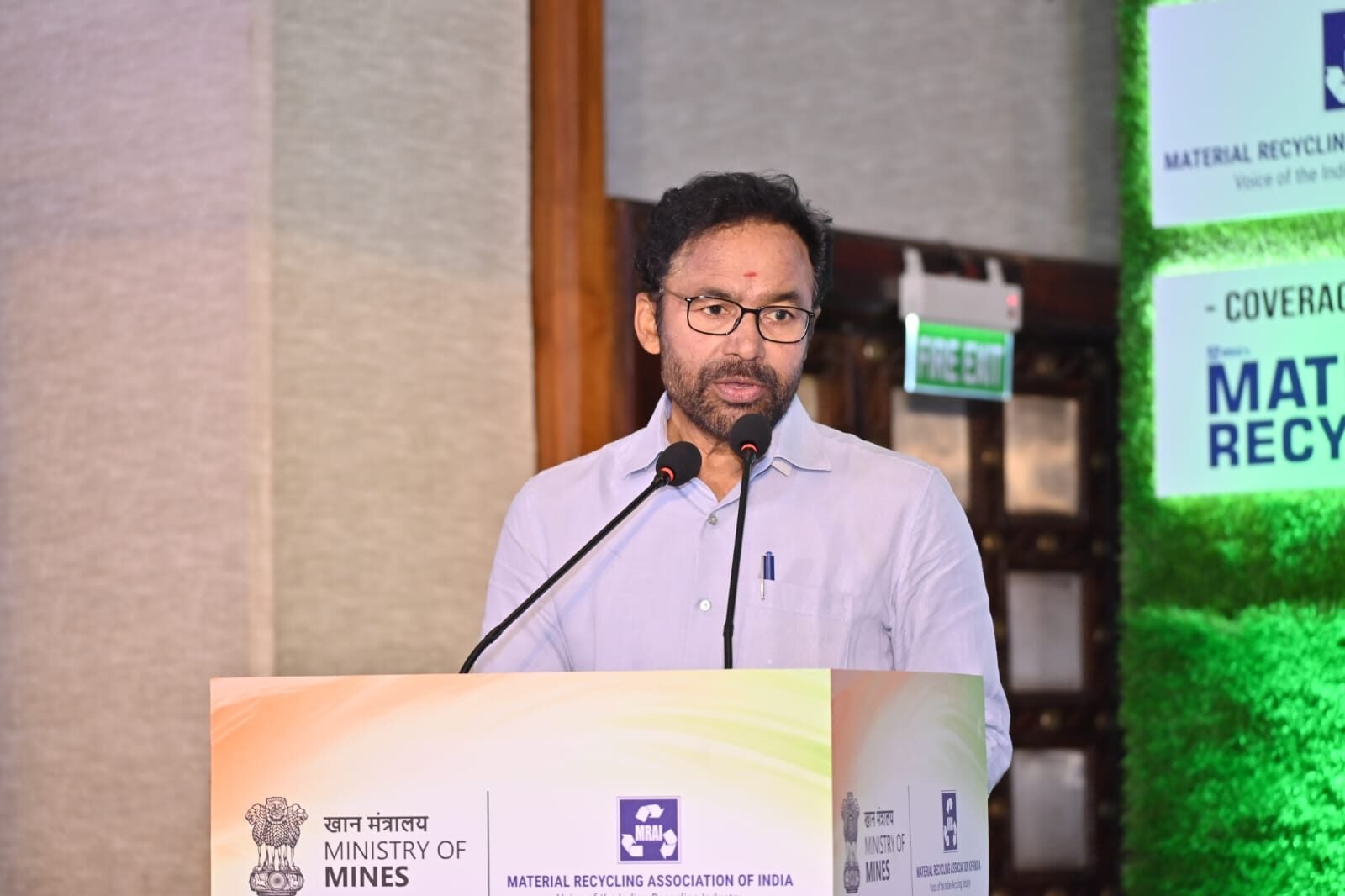
Elaborating the Government’s positive stand on the critical mineral and recycling sector, Reddy emphasised the need to advance critical mineral recycling in line with the vision of Prime Minister Narendra Modi, with a focus on innovative technologies, entrepreneurship, e-waste management and environmental sustainability.
G Kishen Reddy said India could emerge as a significant secondary source of critical minerals by recovering valuable materials from waste, thereby reducing dependence on conventional mining as well as the environmental burden associated with it. He stated that the Government is preparing an incentive scheme for critical mineral recycling and has allocated about Rs 34,000 crore for critical mineral development. Centres of Excellence through IITs and other technology institutions are also proposed to advance research, recovery and processing technologies.
𝐈𝐧𝐝𝐢𝐚’𝐬 𝐧𝐞𝐱𝐭 𝐦𝐢𝐧𝐞 𝐢𝐬 𝐧𝐨𝐭 𝐮𝐧𝐝𝐞𝐫𝐠𝐫𝐨𝐮𝐧𝐝. 𝐈𝐭’𝐬 𝐢𝐧 𝐨𝐮𝐫 𝐜𝐢𝐭𝐢𝐞𝐬.
E-waste, batteries and solar panels hold critical minerals. Recover them, and we build Aatmanirbharta, one ton at a time.
Addressed the National Seminar on India’s Critical… pic.twitter.com/CfAlspjszk
— G Kishan Reddy (@kishanreddybjp) September 21, 2026
The Minister stressed the need for a whole-of-government and society-wide approach, with employment generation, reverse logistics and domestic processing forming the backbone of the recycling ecosystem.
Among the various demands made by the material recycling industry, MRAI stated that abolition of the mandatory PSIC regime for imports of ferrous and non-ferrous metal scrap was among the key demands. The association sought a stronger, technology-driven and India-based inspection mechanism that would facilitate the movement of recyclable raw materials while retaining stringent safety, compliance, scanning and radiation-monitoring requirements.
MRAI stated that the industry was not seeking any dilution of inspection requirements, but a stronger and more secure system capable of handling the scale of India’s scrap trade. Sanjay Mehta, President, MRAI said, “The industry is not asking for less inspection. We are asking for a stronger, smarter and more secure inspection system that is capable of handling the scale of India’s scrap imports. When India already has the infrastructure to scan and verify consignments at its ports, there is a strong case for undertaking verification within the country rather than depending entirely on an overseas system that is difficult to scale and monitor,” he said.
“The recycling industry fully supports stringent checks on imported scrap. Our concern is that the inspection mechanism should be secure, transparent and scalable. India should use its own infrastructure and technology to ensure that compliant cargo moves efficiently while non-compliant material is identified and stopped,” Mehta added.
Dhawal Shah, Senior Vice President, MRAI said, “The existing overseas Pre-Shipment Inspection Agency (PSIA) system was increasingly difficult to scale given the volume and complexity of India’s scrap imports, which are sourced from multiple countries and loading locations. It said recent procedural changes had resulted in consignments being held up, blocking working capital and increasing detention, demurrage and logistics costs for recyclers and manufacturers.
The association proposed that scrap imports be permitted through designated Indian ports equipped with scanning and inspection infrastructure, while allowing other ports to join the system after installing the requisite facilities.
Shah, added that around 2,500 containers of scrap are handled daily and overseas inspection and documentation costs are about US$200 per container. It estimated that a port-based verification system could potentially save approximately US$500,000 in foreign exchange outgo every day, apart from reducing delays and associated logistics costs.
MRAI also sought removal of the 2.5% Basic Customs Duty (BCD) on aluminium scrap and Cupro-Nickel alloy scrap, rationalisation of GST on metal scrap and zero-duty access for recyclable raw materials under future Free Trade Agreements. The association also sought Industry Status for the recycling sector, stating that it would improve access to finance, technology and government support.
Keshav Chandra, Secretary, Ministry of Mines, highlighted the strategic importance of critical minerals for India’s economic and national security. He said that critical minerals are essential for clean energy technologies, advanced manufacturing, electronics, defence and other strategic sectors, with rising global demand increasingly influencing geopolitics and supply-chain security.
Sandeep Vasant Kadam, Joint Secretary, Ministry of Mines and Mission Head, National Critical Mineral Mission, emphasised the need to build resilient critical mineral value chains through greater collaboration between government, industry, technology institutions and international partners.
MRAI Secretary General Amar Singh said the seminar built on the association’s June 23 conference on critical mineral recycling and brought critical mineral and non-ferrous metal recycling together on a common platform. Representatives of five Centres of Excellence—C-MET, NML, IMMT, NFTDC and IISc—participated in deliberations on emerging recovery technologies.
The discussions focused on e-waste collection, lithium-ion battery metal recovery, black mass and policy challenges facing the non-ferrous recycling industry. Singh said MRAI would prepare a comprehensive White Paper capturing the industry’s recommendations and roadmap and would also propose a dedicated CEO Roundtable with the Union Minister.