


An Exhibition showcasing cutting‑edge innovations in Coldwater fisheries was organized on the sidelines of the conference, featuring 17 Exhibitors from various institutions, Government agencies, Industry leaders, and progressive enterprises displaying innovative technologies, quality inputs, and best practices. Exhibitors included the National Fisheries Development Board; Department of Fisheries, UT of J&K; SKUAST‑Jammu; NABARD; Kashmir Trout; K2 Aquaculture Pvt. Ltd.; ICAR‑Central Institute of Coldwater Fisheries Research; National Cooperative Development Corporation; Garware Technical Fibres Ltd., Sindh; Trout Live Fish Vending Centre; Ganderbal, MKC Foods, Matsya Seva Kendra from Kupwara along with Trout feed companies such as Growel Trout Feed, ABIS Trout Feed, Affarwat Trout from Baramulla, and JK Trout Feed.
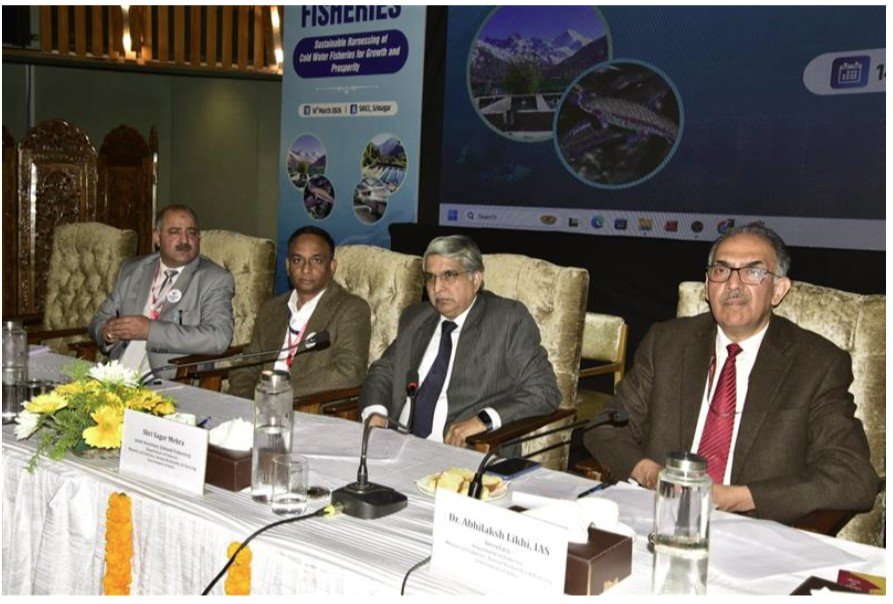
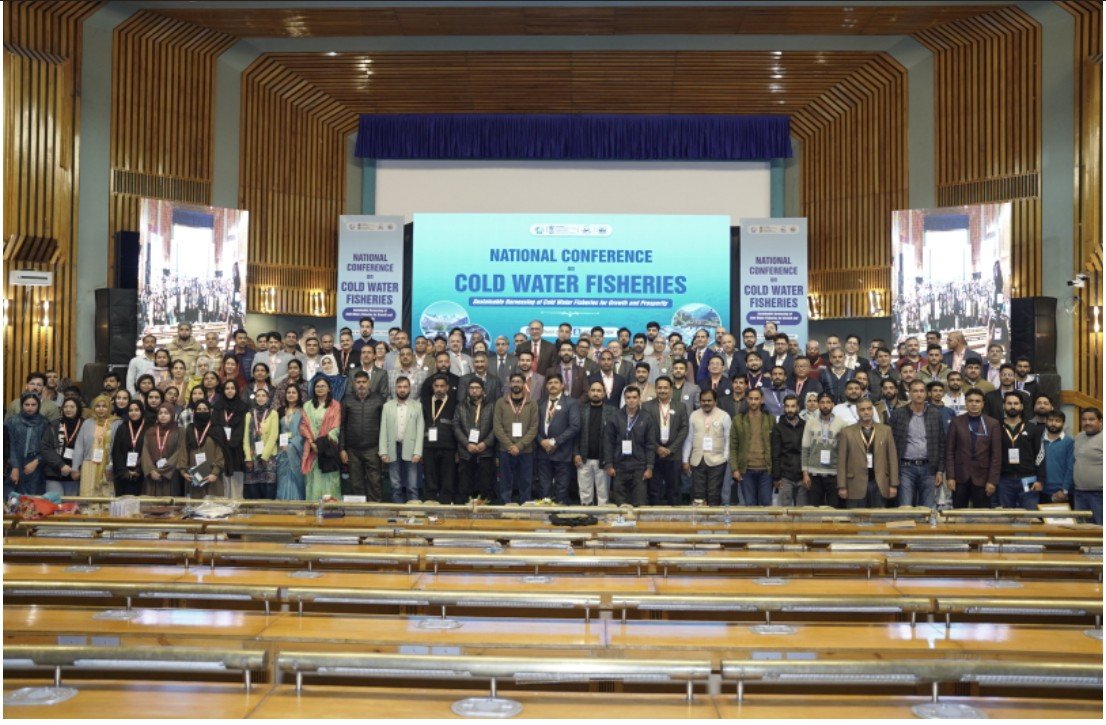
During the Conference, Technical Sessions were organized by Department of Fisheries, GoI to deliberate on key thematic areas including research and innovation, technology adoption, infrastructure expansion, institutional convergence and entrepreneurship development with various stakeholders. The sessions were chaired by Dr. Abhilaksh Likhi, Union Secretary, Department of Fisheries, Government of India, with Sagar Mehra, Joint Secretary (Inland Fisheries), DoF, and Dr. J.K. Jena, DDG (Fisheries), ICAR, as Co‑Chairs. The session brought together Academia, Industry representatives, Experts, Entrepreneurs, and Progressive Fish farmers.
During the session Dr. Abhilaksh Likhi, Union Secretary, Department of Fisheries, Government of India interacted with Entrepreneurs, Stakeholders and gained insights into the on-ground potential and challenges of cold water fisheries in Jammu & Kashmir and other Himalayan regions, with discussions focusing on technical aspects of sectoral development.
Fish farmers gave key suggestion including need for disease testing laboratories, regular seed availability, capacity building requirements, climate-resilient seed availability and water scarcity.
Pravesh Bisht, Secretary, Uplagajna Samiti, Uttarakhand, shared field-level challenges including water contamination, improved laboratory support, and oxygen depletion in raceways during rainfall.
Qaiser Kaunanain, Khyber Aquaculture discussing Entrepreneurship development highlighted the importance of strengthening entrepreneurship through vertical integration, and improved access to schemes such as FIDF for enterprise expansion. He noted that the growth of cold‑water aquaculture depends on the availability of skilled manpower, and the adoption of efficient production and business models tailored to mountain ecosystems.
Aditya Rithvik Narra, Founder, Smart Green Aquaculture, Hyderabad noted that cold‑water fish production remains limited due to commercial‑scale adoption and technological innovation.
Across the four sessions, various stakeholders highlighted the need to establish a multi‑state cooperative society for rainbow trout across cold‑water states, need to advance research and innovation, improving seed and broodstock availability, and strengthening disease investigation and biosecurity systems. The discussions highlighted the need for FSSAI‑approved processing and value‑addition facilities equipped with IQF, tunnel or blast‑freezing systems for cold‑water States/UTs to meet export‑grade phyto‑sanitary standards, along with a robust cold‑chain network to reduce losses.






Heard some whispers about lotogreenbet. Anybody had a good run there? I’m curious before I hop in! Check it out at: lotogreenbet